


Comet 3I/ATLAS, 3I ATLAS, interstellar comet, Oumuamua, Borisov, interstellar object, NASA
10/17/20255 min read
When 3I/ATLAS swept through the planetary system, people saw a miracle, science saw a problem, and nature… simply did what it always does.
Perhaps, for the first time in a long while, it wasn’t the comet that came from another world — it was our understanding of physics that went backward.
3I/ATLAS vs. Earthly Fantasy
🪐 Comet 3I/ATLAS – On the Typicality of Atypical Phenomena
A very controversial object has recently appeared in our sky — the comet 3I/ATLAS. And just like with its predecessor, ‘Oumuamua, numerous conspiracy theories, hypotheses, and even religious threads have emerged around it. In the media and beyond, there is not so much outrage as a kind of fascination and confusion among scientists, arising from people overinterpreting what is factual. But let’s stop for a moment and ask — whose fault is it really?
🔭 How long have we really been studying comets?
We have only been studying comets precisely and systematically for about two decades. Thanks to missions such as Rosetta (ESA, 2004–2016), Deep Impact (NASA, 2005), and Stardust (NASA, 2004), we were able to examine, for the first time, the composition and structure of cometary nuclei, as well as their mass, density, and activity.
But let’s be honest — we only studied our own backyard: comets from the Solar System that return cyclically and are easy to predict.
For contrast, take Halley’s Comet, observed since antiquity. In Chinese, Babylonian, and medieval records, it was described as a “fiery dragon” or a “harbinger of the end of the world.” No one knew at the time that it was the same object returning every 76 years. Only Edmond Halley in the 18th century connected the observations from previous centuries and demonstrated that it was a single comet orbiting in a closed loop.
Since then, we have seen it seven more times, and the Giotto probe (ESA, 1986) was the first to photograph its nucleus. And it is from such local observations that the notion of a “typical comet” was born.
🪐 Why 3I/ATLAS is not strange — just foreign
3I/ATLAS, the third known interstellar object (after ‘Oumuamua and 2I/Borisov), behaves completely differently from our Solar System’s comets. Instead of fading as it moves away from the Sun, it continues to emit water and gases even at 2.9 AU, where temperatures drop to around −120 °C, and most comets in our system would have long “gone to sleep.”
According to measurements by Zexi Xing and Dennis Bodewits of Auburn University (2025), 3I/ATLAS continues to release about 40 kg of water per second, and more than 8% of its surface remains active. These are levels unheard of among Solar System comets.
Compare this to 2I/Borisov, the first truly observed interstellar visitor in 2019. Borisov behaved quite “normally” — its gas activity decreased with distance from the Sun. ATLAS, on the other hand, does the opposite — it maintains emission much longer. This isn’t magic — it’s atomic structure. It was formed in a different energetic environment, under a different field and pressure distribution.
⚛️ The myth of the “typical comet”
When we hear that 3I/ATLAS “behaves unusually,” we should add: unusually for us, not for comets in general. The term “typical comet” is statistical, not physical. The fact that something deviates from our model doesn’t make it an anomaly — it just doesn’t fit within our narrow reference frame. It’s like comparing a deep-sea fish to a river fish and saying the first one is “weird.” It’s not — it just lives in another world.
🪐 What we actually know about 3I/ATLAS
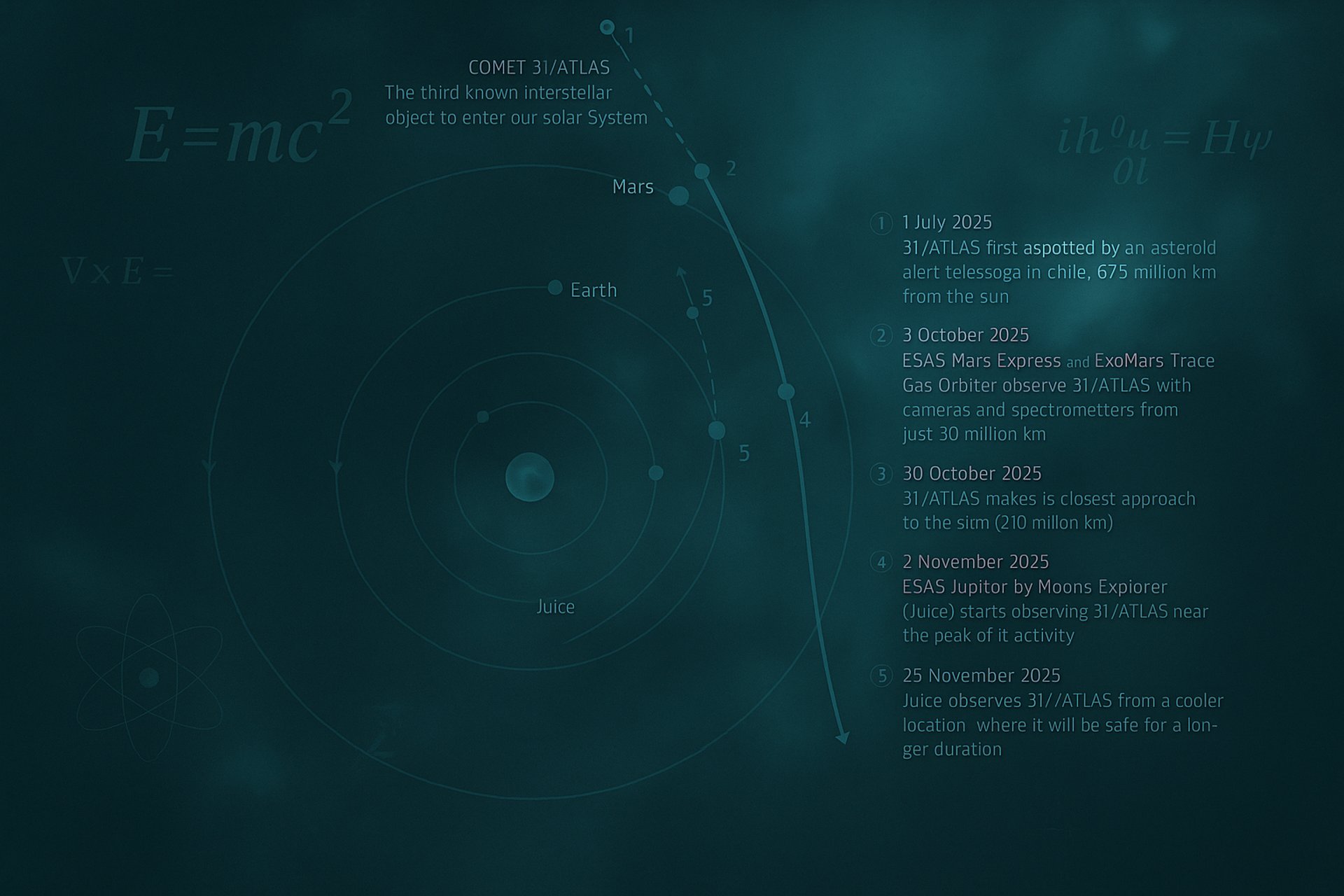
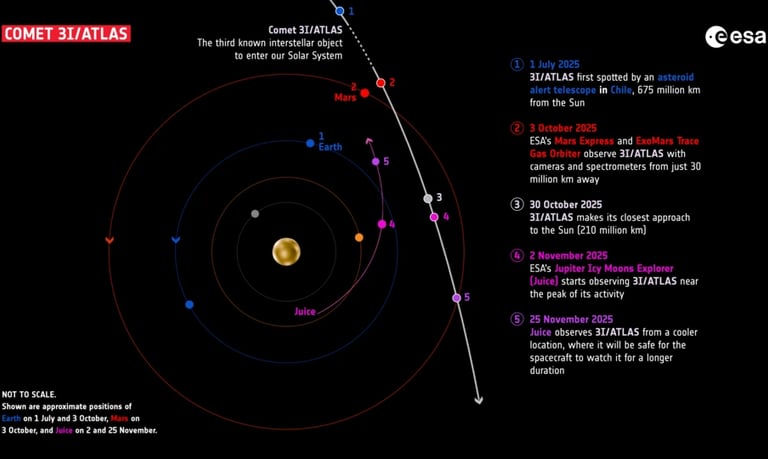
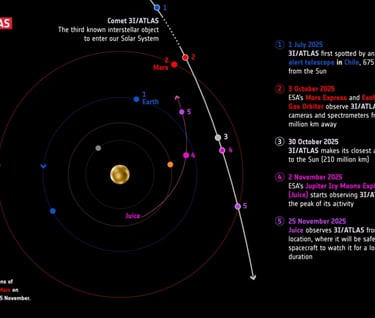
Comet 3I/ATLAS was discovered on July 1, 2025, by the ATLAS (Asteroid Terrestrial-impact Last Alert System) telescope network in Chile. Its orbit is clearly hyperbolic, meaning it is not gravitationally bound to the Sun — it came from interstellar space and will likely leave the Solar System after its passage.
According to NASA Science (2025), its velocity relative to the Sun is about 58 km/s (over 210,000 km/h), making it one of the fastest objects ever observed in our system.
The perihelion, or closest point to the Sun, occurred on October 29, 2025, at a distance of 1.36 AU, and earlier the comet passed Mars at a distance of just 0.19 AU. Trajectory analysis from NASA/JPL Horizons indicates that its path is nearly straight, with an eccentricity of e ≈ 1.15, confirming its interstellar origin.
Initial measurements estimate its nucleus to be between 0.6 and 5.6 km in diameter — relatively large for a comet — and yet highly active. Even at 2.9 AU, where the temperature drops to −120 °C, 3I/ATLAS continues to emit water.
According to Auburn University (Xing et al., 2025), the comet releases about 40 kg of H₂O per second, with over 8% of its surface active. Moreover, carbon dioxide (CO₂) is emitted at several times the rate of water, indicating a chemically “foreign” origin. Spectroscopic observations by NASA, ESA, and Keck telescopes detected hydrogen cyanide (HCN), carbon monoxide (CO), and trace amounts of nickel in atomic form — components rare in local comets but typical for matter formed in the cold, outer regions of the galaxy.
The greenish glow seen in Hubble and JWST images adds another mystery. In most comets, this hue comes from C₂ molecules that emit green light when broken by UV radiation. However, in 3I/ATLAS, the amount of C₂ is negligible — suggesting another source of emission, possibly magnetic field interactions or organic tholins formed by prolonged interstellar radiation exposure.
While sensational headlines claim that “the more scientists look, the stranger it gets,” in truth this is not an anomaly — it’s the first real look at matter beyond our system. The persistence of water and ion emission far from the Sun shows that the conditions necessary for ices and organics are far more common in the galaxy than previously believed.
For science, 3I/ATLAS is not a mystery — it’s a comparative window showing how matter evolves under different conditions. There’s nothing “unnatural” about it — it’s simply typical for its own environment, just as Earth is for ours.
🧩 Who fuels the conspiracy mill?
It’s not “people on the internet” who create interpretive chaos — it’s the scientific narrative itself, which too often classifies before it observes. When scientists label something “unusual behavior” before understanding it, they open the door to all sorts of “alternative explanations.”
Thus, science itself fuels the conspiracy mill — comparing the unknown to the known and losing sight of the purpose of inquiry.
🧠 Author’s Reflection
I am not searching for new particles or miraculous exceptions to the laws of nature. I’m searching for simplicity — the same that guided Newton, Tesla, and Faraday. Phenomena don’t need new names; they need a unified understanding. Physics has fragmented into dozens of languages and hundreds of formulas, yet the universe doesn’t complicate itself — we complicate its description because we fear admitting that simplicity might be true.
We don’t need to invent new entities — we just need to connect the ones that already exist and see that from the atom to the galaxy, they all follow the same logical structure.
📚 Observational Sources
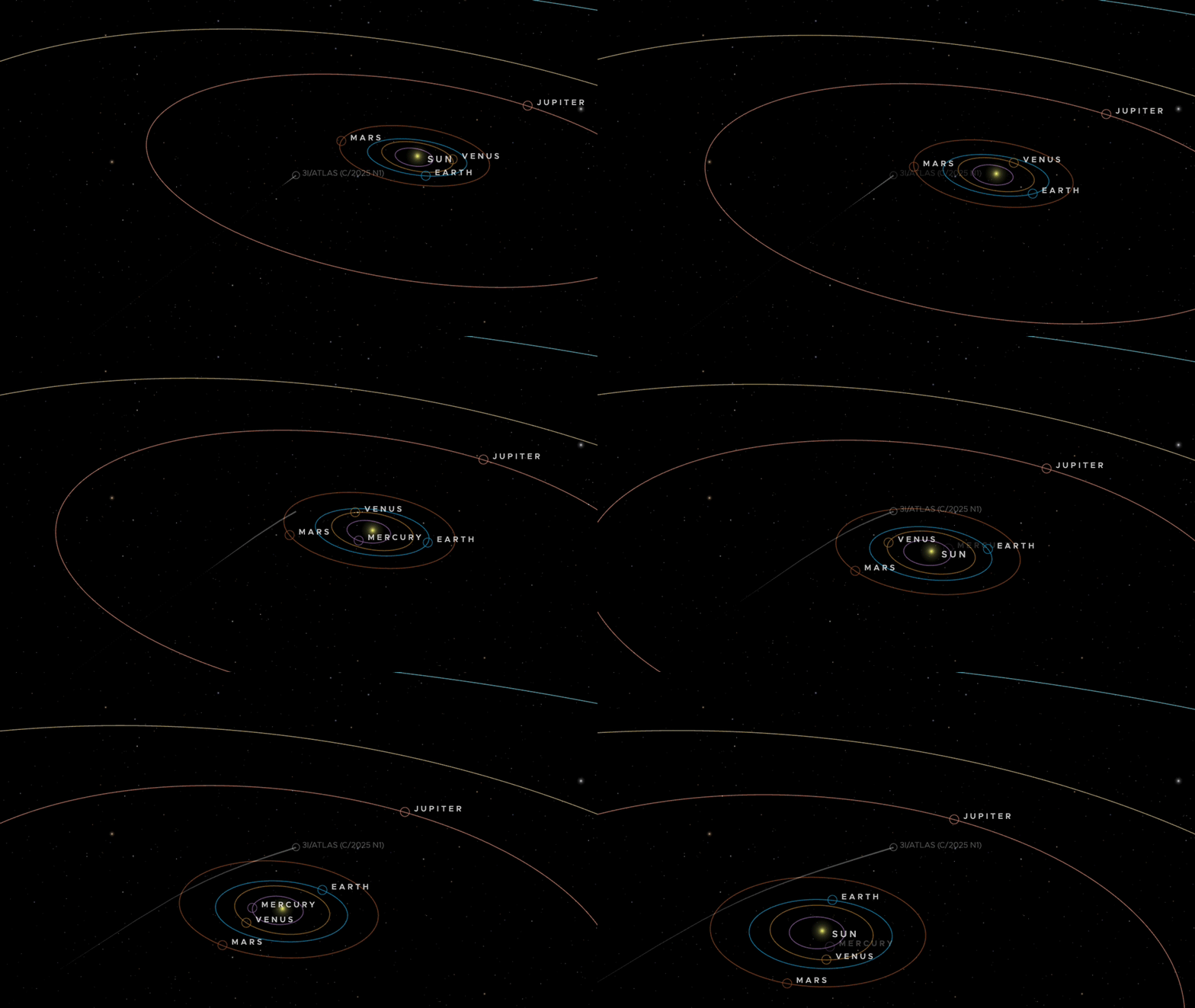
Animation of comet 3I/ATLAS's trajectory through our solar system.NASA/JPL

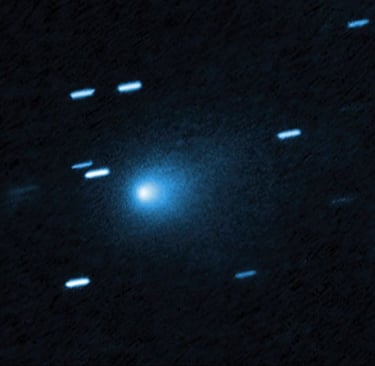
Hubble captured this image of the interstellar comet 3I/ATLAS on July 21, 2025, when the comet was 277 million miles from Earth. Hubble shows that the comet has a teardrop-shaped cocoon of dust coming off its solid, icy nucleus. Image: NASA, ESA, David Jewitt (UCLA); Image Processing: Joseph DePasquale (STScI)